Why Precision Matters: How CNC Machining Ensures Accuracy and Quality

Why Precision Matters: How CNC Machining Ensures Accuracy and Quality

Why Precision Matters: How CNC Machining Ensures Accuracy and Quality

Have you ever questioned what distinguishes a part that works perfectly for many years from another one that goes wrong shortly? The solution often boils down to one word—precision. In sectors where tolerances are taken in microns, and quality cannot be compromised, precision CNC machining remains the gold standard of absolute manufacturing quality. 

Defining Precision in Today’s Manufacturing 

Precision is not merely being within the limits of specifications; rather, it is consistently obtaining exact measurements, part after part, day by day. In the sector of metal fabrication that businesses in Sydney rely on, precision CNC machining is seen as the channel for advanced technology, skilled labour, and strict quality control that are all working together.  

Computer Numerical Control (CNC) machining has brought about the biggest change in manufacturing by eliminating human error. Traditional machining was very much dependent on the operator’s skill and manual adjustments, whereas CNC systems carry out programmed instructions with mathematical precision. This technology gives rise to accurate machining services that are capable of replicating complex geometries and maintaining tight tolerances across production runs of any size. 

The Technology Behind Precision CNC Machining 

Contemporary CNC machines function by means of highly sophisticated multi-axis systems that can accurately position cutting tools within a thousandth of a millimetre. Servo motors, linear encoders, and high-tech feedback systems are the main components of these computers that monitor cutting, and positioning is done by adjusting it instantly. This level of precision will be very difficult to reach if the whole operation is done manually. 

The accuracy starts with computer-aided design (CAD) and computer-aided manufacturing (CAM) software. The engineers make intricate 3D models illustrating every dimension, tolerance, and surface finish requirement. The digital blueprint is subsequently converted into machine code, which controls the CNC equipment’s accurate cuts, drilling, and contouring. 

Temperature control is crucial for accuracy. The of the metal’s size will depend on its temperature, which might as a result alter the dimensions. Metal fabrication Sydney companies control the climates in their workshops and let the materials cool down before machining. Other high-tech operations even implement temperature compensation algorithms that modify tool paths in accordance with the found temperature discrepancies. 

Why Accuracy Matters Across Sectors 

In the field of aerospace, accuracy is not only important, but it is also necessary. The parts of the aircraft are supposed to be very precise, and the tolerances that they must meet are very tight, keeping in mind the performance and the safe journey at high altitudes. A turbine blade that has been manufactured incorrectly could cause a failure that would result in a tragedy. Therefore, precision machining services with quality control documentation and complete traceability are the standards set by aerospace manufacturers. 

The medical industry is another one where the same precision is required. If surgical tools, implants, and diagnostic devices are made by using CNC machining, they will be safe and good for the purpose. An orthopaedic implant must get the specifications of the bone and be made accordingly to integrate with the bone challenging and soft tissues. Surgical tools need to follow the dimensions very closely to get the job done without causing damage. 

To a certain extent, even less dramatically critical applications show precision in their direct benefits. Automotive parts made to very narrow specifications are more efficient, have longer life cycles, and generate less heat and friction. Inaccurate parts in industrial machinery lead to more downtime, higher repair costs, and a shorter operational life for the machine. 

Quality Assurance in Precision Machining 

To achieve precision, a complete quality assurance system is necessary alongside good equipment. Professional operations set up multiple checkpoints during the manufacturing process to verify the accuracy of the parts at every stage. 

Usually, the process starts with the first article inspection, where the initial production part is measured in detail to ensure it meets all the specifications. Coordinate Measuring Machines (CMMs) touch many different spots on the component’s surface, and a detailed map is created that is compared with the CAD model. This way, any defects are detected and fixed before the regular production starts. 

In-process inspection helps to deal with a problem before it spreads to a lot of parts. During machining, the operators have the precision measuring tools such as micrometers, height gauges, and optical comparators to check the critical dimensions. Also, the statistical process control (SPC) methods are there which follow the measurement data over a period and spot the trends which could point to the need for changing the tool due to wear or other parameters that are affecting accuracy. 

Final inspection is the stage where the maximum assurance is given that the components conform to the specifications. Besides checking the dimensions, the inspectors also assess the surface finish, edge conditions and other quality characteristics. There are Documentation packages that go along with the finished parts, which give total traceability and proof of compliance with the requirements. 

Material Selection and Precision Outcomes 

The material properties and machining precision relationship is frequently underrated. Various metals have different reactions to cutting forces, heat generation, and tool pressure. Knowing these characteristics is crucial for getting the best results in projects involving metal fabrication Sydney. 

Aluminium alloys are easy to machine and have excellent dimensional stability together, which makes them a first choice for precision parts. Nevertheless, there are different characteristics depending on the grade of aluminium. 6061 aluminium is very machinable and strong, meanwhile, 7075 gives higher strength but requires more careful machining parameters. 

Stainless steel is a challenge because of its hardness and the fact that it is going to get harder the more you cut. The precision of stainless-steel machining depends on the right tooling, cutting speeds, and coolant application. The output, though, is a product with excellent resistance to corrosion and durability even under the most demanding applications. 

Exotic materials such as titanium and Inconel require the expertise of a specialist in precision CNC machining. These materials are hard to machine but have the properties that would be very useful for the aerospace, medical, and high-performance applications. The work on such materials means knowing their behaviour under different machining conditions in order to precisely control the tool life and maintain accuracy. 

The Human Element in Automated Precision 

Nevertheless, precision CNC technology still requires skilled labour to be consistently done. Deep understanding of the factors that govern machining like process, material features, and tooling capabilities is a prerequisite for programming complex parts. Then, the experienced programmers work out the tool paths in such a way as to reduce the generation of vibrations, control the heat being made, and get the best possible surface finishes. 

The machine operator is the one who takes care of production on his/her own by doing some slight changes in the process to keep accuracy throughout. He/she is able to tell when the wear of the tool starts to have an impact on the quality, and he/she will initiate the tool change before the tolerances are overrun. Their skill in the setup protocols makes sure that the work holding fixtures are positioned correctly and securely. 

Quality controllers employ their trained eyes and measurement skills in the verification process. They are familiar with the correct ways of operating precision instruments and interpreting measurement results within the context. Their keen observation detects there might be problems before the products are shipped to the customers. 

Investment in Precision: Long-Term Value 

The companies that give priority to exact machining services consider precision as an investment and not as an expense. The cost of precision manufacturing could be higher at the start, but still, the long-term value proposition is very attractive. 

Accurate parts fit the right way the first time, thus avoiding expensive rework and delaying assembly. They also have a long-service life and, therefore, fewer warranty claims and no damage to the company’s reputation. The quality that precision provides allows to produce faster and with fewer inspections done. 

For businesses that outsource their manufacturing, selecting a precision-oriented metal fabrication Sydney partner brings in a number of strategic advantages. Access to state-of-the-art capabilities without having to invest in capital equipment, flexibility to manage changes in production volumes, and knowledge in making designs for manufacturability all play a part in the company’s competitive edge. 

Precision CNC machining is not an alternative, but rather a necessity in an era where quality expectations are constantly increasing and tolerances are becoming tighter. The manufacturers that are able to achieve the highest accuracy on a consistent basis will be able to use their technology, processes, and know-how as a differentiator from those that just perform to a minimum standard. 

At Advantek, precision is not only a capability but our very foundation. What we have done is to invest in state-of-the-art CNC machines, climate-controlled buildings, and total quality management systems to make sure every part meets the most demanding specifications. Our people of highly skilled machinists, programmers, and quality control experts with their several decades of combined knowledge and skills confer it upon every project. 

Are you prepared to feel the impact of precision? Get in touch with Advantek now to go over your precision CNC machining needs. Our precision and quality guarantees that your parts will work just as they were intended, no matter if you ask for prototypes, production runs, or sophisticated metal fabrication Sydney solutions. For further details about our services and to get a quote for your upcoming project, please visit advantekaustralia.com.au. 

CNC Machining vs. 3D Printing: Which Is Right for Your Next Project?

CNC Machining vs. 3D Printing: Which Is Right for Your Next Project?

CNC Machining vs. 3D Printing: Which Is Right for Your Next Project?

Imagine, you are at a manufacturing crossroads where a project deadline is approaching fast. You can choose CNC machining, a highly precise power, and the other one is 3D printing, a creative and adaptable technique. With both technologies, your design is going to be realised; still, the question arises which one is the best for your exact requirement? This is the dilemma that many engineers, product developers, and manufacturers not long ago faced and still encounter, every day, as they traverse the ever-changing world of modern manufacturing technology. 

Grasping the basic differences between CNC and 3D printing is not merely a choice of two machines. It is to match your project’s needs with the appropriate production process in order to cut down costs, and improve quality, speed, and functionality. Let’s see how these two manufacturing titans compare and help you decide wisely for your next project. 

Understanding the Core Technologies 

CNC machining is a subtractive manufacturing process whereby the computer precisely controls the cutting tools that take away material from a solid block to form the desired part. The cutting method is very reliable and brings very high accuracy. It can be done with metals, plastics, and composites, and thus it is possible to make very small and very smooth parts. CNC machining has been the very backbone of all manufacturing industries for many years. It has given consistent quality results no matter if the industry was aerospace or medical devices. 

On the other hand, 3D printing is using the additive manufacturing technology of building parts layer by layer from the materials like plastic filaments, resins or metal powders. This has changed the way things are done in prototyping and small production by allowing the making of even the most complex forms of the product, which would not be possible or extremely expensive with the traditional methods. Being able to manufacture intricate internal structures and organic shapes makes 3D printing a very good choice for projects that focus on innovation. 

Material Considerations and Strength Requirements 

Material selection is usually the key issue when you are considering CNC or 3D printing for your project. CNC machining has the advantage of offering a very large variety of engineering-grade materials such as aluminium, stainless steel, titanium, brass, and high-performance plastics. The parts made from solid blocks have their material’s original structural integrity, which makes them suitable for high-stress applications where sturdiness and metal properties are both a must and a no-negotiation point. 

3D printing cannot be compared with CNC machining in terms of material selection. However, it still continues to expand its material portfolio. Metal 3D printing has come a long way, but the process of building up the part layer by layer can lead to the development of anisotropic characteristics, where the strength of the part varies depending on the angle of the force applied. For functional prototypes and parts that are not subject to very high stress, modern 3D printing materials are very good. Nonetheless, those parts that are vital for the mission such as the ones needing a certain level of mechanical properties in all directions will still obtain advantages from CNC machining solutions. 

Precision, Tolerances, and Surface Finish 

The precision standards set for the products can noticeably limit the selection of manufacturing technologies. In usual CNC machining practice, it is possible to get tolerances of ±0.025mm or lower, while the quality of the surface finishes is such that in most cases no post-processing is needed. This great level of accuracy makes CNC the primary choice for precision-fit parts such as those used in mechanical assembly, tooling, and critical dimension components. 

The 3D printing technology has undergone a great transformation, and now some of the top-end systems are nearly as precise as CNC. Nevertheless, most 3D printing methods create layer lines that are detectable and the surfaces that require post-processing to achieve smoothness. If your project is such that it cannot compromise on tight tolerances and excellent surface finish straight from the machine, then, CNC machining is always the method that gives superior results with less extra work. 

Volume, Speed, and Economic Considerations 

The production volume has a huge impact on the financial aspects of the project. For prototypes that are created only once or for small batches of less than 50 units, 3D printing is the option that usually provides faster and cheaper solutions because it does not involve tooling or extensive setup. The process can go from digital design to a physical part in a few hours, thus, 3D printing is the way to go for rapid iteration and design validation. 

CNC machining is the exact opposite to 3D printing: it brings about setup time and tool path programming, but when it is all done, you get the parts with great accuracy, constancy, and quickness. The cost of CNC machining drops to a pretty low level during the process of making medium to high-volume production runs. The lowering of the cost per part is a very noticeable effect when there is an increase in the number of parts, coupled with the assurance of the process’s reliability that gives quality uniformly across thousands of units. 

Design Complexity and Geometric Freedom 

3D printing is the technology that stands out when it comes to complicated designs. It is possible to create internal channels, organic shapes, lattice structures, and topology-optimised designs without the geometric limitations that cutting tool access imposes. The designers’ challenge is to find the best way to combine performance and manufacturability; hence, they can reduce weight and material consumption while keeping the component strong. 

On the other hand, CNC machining will not let the designer’s creativity go wild, as it does not accept internal features and undercuts that the cutting tool cannot reach. Yet, with multi-axis CNC machines, the possibilities of geometry are greatly extended, and a skilled machinist can still produce intricate parts largely because of the smart fixture and optimal part orientation. For precise external features, CNC often beats 3D printing in terms of quality. 

Making Your Decision 

The decision of whether to go for CNC or 3D printing comes down to the unique needs of your project. When superior material characteristics, very close tolerances, perfect surface finish, or medium to high production numbers are the criteria, then CNC machining is the technology to be considered. It is the best option for functional end-use parts and tooling applications where trustworthiness is the main concern. 

On the other hand, when the needs of the project are the opposite, then 3D printing is the right choice. This is the case for rapid prototyping, complex designs that take advantage of the freedom of design, low-volume production, or when fast-turnaround is required for design iteration. The technology particularly suits projects where weight reduction through internal structures provides significant advantages.
 

Conclusion 

CNC machining and 3D printing are both considered to be top-notch manufacturing technologies, but each has its own merits that can be considered in different situations. The best choice will be made depending on the precedence given to the material needs, precision standards, production quantity, complexity, and time in your project. Many of the manufacturers that have had great success have been the ones that have been using these two technologies in a smart way, that is, they have been using 3D printing for creating prototypes and validating designs before going to CNC machining for large-scale production runs.  

Are you ready to use the right manufacturing method to turn your next project into a reality? The knowledgeable personnel at Advantek Australia, who are well-versed in both CNC machining and state-of-the-art manufacturing technologies, will aid you in picking the right solution tailored to your needs. No matter if you need precision components or new production methods, we will provide high-quality outcomes that conform to your project specifications and schedule. Go to advantekaustralia.com.au now to talk about your project with our manufacturing experts and find out how we can make your designs come true. 

Benefits of CNC Routing in Architectural & Interior Design Projects

Benefits of CNC Routing in Architectural & Interior Design Projects

Benefits of CNC Routing in Architectural & Interior Design Projects

Australia’s architectural and interior design scenario is witnessing a major change, and the credit goes to precision technology which, as it were, converts innovative ideas into real masterpieces. One of the major factors contributing to this change is CNC routing technology—a very advanced manufacturing process that is changing the way designers, architects, and builders handle complicated projects. If you are imagining a modern house in Sydney or if you are working on the interiors of a commercial building throughout Australia, then knowing the benefits of CNC routing in architecture can really improve your project outcomes.  

What is CNC Routing, and Why Does It Matter? 

The Computer Numerical Control (CNC) routing technology is the point where the digital design meets precision manufacturing. This cutting-edge technology is utilising computer-controlled cutting tools for the purpose of turning raw materials into complex architectural parts with very high accuracy. CNC routing, as compared to traditional fabrication methods that depend on and are thus limited to manual skills, and which are also prone to human errors, offers modern design projects with consistent, repeatable results that totally meet the standards of the day.  

To architects and interior designers, this technology is a source of unprecedented creative possibilities. Not only are complex geometric patterns, but also intricate decorative panels, and custom architectural features that were once prohibitively expensive or technically challenging are now achievable with remarkable efficiency. 

Precision That Brings Design Visions to Life 

One of the major advantages of technology in the field of architectural and interior design is its ability to make the creative idea come to life without any deviation. The precision of CNC routing technology is to such an extent that the millimetres are even being divided to get the perfect match of the digital specifications for every curve, angle, and cutout. The accuracy of this technology is particularly important for the following projects: 

  • Custom decorative screens and room dividers 
  • Intricate facade panels and cladding systems 
  • Bespoke furniture components with complex joinery 
  • Architectural trim and mouldings with detailed profiles 
  • Signage and way finding elements with precise lettering 

With the CNC routing method, the quality of the individual pieces is simply outstanding, all the way from the manufacturers’ prototypes to the hundred identical panels. This elimination of quality variations does bring about the same gradual installation and a more delicate final appearance that are common in manual processes. 

Diverse Material Options for Every Design Aesthetic 

One of the main features of CNC routing that makes it attractive for architecture is the fact that it can be applied to many different materials. Today’s CNC machines can cut and shape a wide variety of substrates, which gives the designers the opportunity to choose the materials that will not only be the most beautiful, but also the most functional and economical that are the closest match to their original concepts.  

Engineered Plastics: High-density polyethylene (HDPE), acrylic, and polycarbonate, to name a few, have the advantage of being incredibly long-lasting, as well as being very flexible in terms of design and able to withstand even the toughest weather conditions. They are thus suitable for both indoor and outdoor applications, where the materials need to have a long-life span. 

Timber and Composite Materials: The spectrum of materials with CNC routing extends from premium natural hardwoods over to environmentally friendly MDF and plywood. The machine cutting brings in more of the natural warmth and beauty of the timber to the spaces with the precisely cut timber actors. The technology can perform delicate lattice work, detailed engravings, and complex joints, all to the extent that it is possible to see the beauty of the wood grain. 

Metal Substrates: Metals such as aluminium, brass, and even steel can be routed with precision to bring out the hidden contemporary aspects. A modern-day design using perforated metal screens for walls or decorative wall panels that impart an industrial character to the interiors can be easily made out of brass, for example. 

Speciality Materials: CNC processing capability has made it possible to handle advanced composites, solid surface materials, and even stone, thereby creating powerful design statements with custom interior CNC panels that are very much attractive and creative. The flexibility of materials gives the designers the power to play around with textures, finishes, and combinations that create unique spatial experiences. 

Scalability from Concept to Completion 

The journey of every architectural project from the initial concept to the final installation is different. The CNC routing technology keeps supporting this whole journey with great scalability. It does not matter whether you are making one sample for client approval or producing hundreds of panels for a small-scale commercial fit-out, CNC routing can easily change according to the specific needs of your project.  

Prototyping and Iteration: CNC routing is a rapid prototyping tool for architectural elements during the design development phase. Physical samples can be quickly made by designers, assessed in context, modified, and new versions made again—all this without incurring significant time or cost penalties. 

Small Batch Production: For projects in the boutique sphere or custom residential designs that need just a few pieces of customised parts, CNC routing gives the chance of a cost-effective small batch production without losing high quality and precision. 

Large-Scale Manufacturing: If the project requires a lot of identical pieces, like hundreds of decorative panels for a hotel lobby or office, then CNC routing will ensure that all pieces have the same quality and it would still be producing under good timelines. 

This flexibility of production levels is especially beneficial for the Australian market, where projects can be from small residential renovations to large commercial developments, having different requirements for production. 

Accelerated Timelines Without Quality Compromise

Project timelines in the competitive construction and design industry directly impact profitability and client satisfaction. Compared to traditional fabrication methods, CNC routing contributes to the manufacturing process speed significantly while still maintaining the quality that sets apart incredible architectural work. 

Installation of automated CNC systems requires minimal supervision as they work non-stop, which leads to a drastic reduction in production time for complicated parts. CNC machine taking highly skilled manual labour that might take days or weeks have often done in hours. This leads to project completion time being shorter and labour cost being lower, as well as strict construction deadlines being met. Also, precision of CNC routing saves materials as well as time not having to do corrections or remakes because of fabrication errors which are common in manual production. 

Additionally, the accuracy of CNC routing helps to save on materials and avoids spending time on corrections or remakes where there have been fabrication errors, which are often the case with manual production. The same efficiency applies to the installation phase, where components made with the utmost precision fit perfectly into each other and save time for adjustments on the site. 

Cost-Effectiveness Through Manufacturing Efficiency

The cost of investing in custom architectural elements may be high, but the exceptional value of CNC routing is through the efficiency of the manufacturing process. The precision of the technology leads to material being wasted, as the cutting paths are optimised to give the maximum yield from each sheet or board. This efficiency is of great importance when using premium materials where waste is a direct impact on project budgets. 

The reduction in labour cost is another major benefit. CNC routing takes over the cutting and shaping processes that are complex and would require highly skilled craftsmen working for long periods of time. This automation, however, does not mean that the need for skill and expertise is completely eliminated—it is just the area that the expert skills will be directed toward will be design optimisation, quality control, and finishing work that adds maximum value. 

In the case of projects that need repetition—identical panels, recurring pattern elements, or standardised architectural features—the cost per unit becomes much lower with CNC production as compared to handcrafted techniques. Therefore, the sophisticated design elements will be available to a larger variety of projects and budgets. 
 

Environmental Sustainability in Design Manufacturing 

Sustainability considerations increasingly influence material selection and manufacturing processes in Australian architecture and design. CNC routing contributes positively to environmental goals through several mechanisms. 

CNC cutting’s accuracy effectively limits the waste of materials by applying cutting paths and nesting patterns that extract the most usable pieces from the raw materials. In contrast to methods that leave large amounts of offcuts or need bigger raw pieces to compensate for manual cutting tolerances, CNC routing is a material-friendly process. 

The majority of the engineering plastics commonly employed in CNC routing are of recyclable type or composed of recycled (post-consumer) material, thus they comply with the idea of circular economy. In addition, the possibility of selecting strong, long-lasting materials for the CNC-manufactured construction parts not only reduces the number of replacements but also leads to a smaller total environmental impact during the building’s life cycle. 

Why Choose Advantek Australia for All Your CNC Routing Requirements 

When it comes to making architectural dreams come true with exact manufacturing, Advantek Australia is the CNC routing partner of choice for Sydney. Our Australian-owned factory located in Wetherill Park mixes state-of-the-art technology with a high level of engineering expertise to provide excellent results for architects, interior designers, and builders all over the country.  

Comprehensive In-House Capabilities: Our high-tech manufacturing factory provides complete solutions from A to Z, including initial design, CAD modelling, CNC routing, finishing, and quality assurance all in one place. This integrated system offers the advantage of a single point of control over the quality, communication, and timeline of the project.  

Material Expertise: Depending on your needs, we would recommend the suitable material that will give you the best performance, aesthetics, and budget. Our considerable stock of engineering plastic grades means no waiting for material sourcing when we start your project. 

Scalable Production: No matter if your project demands just one prototype, small batch production, or massive volume manufacturing, our versatile production capabilities can handle any project size while still maintaining the same high level of quality and precision.  

Collaborative Design Support: From concept to completion, our team partners with designers and architects closely. We provide design optimisation suggestions that not only enhance manufacturability but also keep the creative intent, thus guaranteeing that your vision is perfectly translated from the digital model to the tangible reality. 

ISO 9001:2015 Certification: The quality assurance is through the ISO 9001:2015 certification, which is our formal commitment to quality, and it indicates that we have a set of processes in place that are systematic and deliver consistent, dependable results for each project.  

Proven Track Record: In the past, we have delivered manufacturing solutions to various industries like food processing and medical and even to defence and transport. This wide experience is one of the factors that enable us to adopt the right approach to architectural projects by sharing insights from the different sectors of the industry to overcome the unique challenges presented by the design. 

Conclusion: Transform Your Design Vision with Precision CNC Routing 

CNC routing is not only a means of doing things simple, it has numerous advantages which by the way the process is not limited to manufacturing. The technology has opened new avenues in the way the designers think about the realisation of their ideas inspired by the characteristics of CNC routing which are, precision, material versatility, scalability, and most importantly cost-effectiveness. In fact, these very characteristics make it possible for the truly impressive architectural dreams to be turned into reality. 

As the Australian architecture is taking another step towards more complex and unique design solutions, it becomes imperative to cooperate with a manufacturing expert who has a firm grasp of the entire process—the capabilities of CNC routing as well as the demands of the architectural project in terms of creativity. 

Do you want to take your next architectural or interior design project up a notch by using a precise CNC routing technique? The Advantek Australia team is ready to make your artistic ideas an extraordinary reality. Please get in touch with us right away to talk about your project needs, look into the different materials, and find out how our cutting-edge CNC routing can achieve your vision quality-wise without compromise. 

Contact us right away: 

  • Phone: +61 2 9604 8772
  •  Mobile: +61 423 706 357
  • Location: 3/80 Hassall Street, Wetherill Park NSW 2164 

We are excited to collaborate with you to envision and build a masterful union of precise manufacturing and inspired design.

From Design to Reality- How CNC Routing Brings Custom Parts to Life

From Design to Reality- How CNC Routing Brings Custom Parts to Life

From Design to Reality- How CNC Routing Brings Custom Parts to Life

We all begin with an idea at the drawing stage and question if it’s possible — “Sketches, do they evolve?” That’s the question raised and answered by CNC routing within manufacturing. It is a wonder to see a design nurtured from a mere benevolent thought to a physically precise instance. Be it from the conception of plastic thin-prototype products, or heavier metal parts; custom CNC routing gives wings to ideas. Let us delve into examination of this seamless process, and the wonder it works with Australian manufacturing.

Understanding CNC Routing: Precision Meets Creativity

The fundamental concept behind CNC Routing (Computer Numerical Control Routing) is automating cutting machinery using computer instructions to accurately cut out shapes from various materials like plastic and metal. This technology allows businesses to use custom CNC cutting in Australia with great ease and remarkable accuracy to meet every requirement of the materials. Leading companies like Advantek Australia don’t just offer custom routing services, but also provide high-tech precision CNC router machines that can transform digital drawings into meticulously made parts.

The End-to-End Process: From Concept to Completion

Design & Modelling

It all begins with an idea. Maybe a quick sketch, a CAD design, or even a scribble on a napkin. Advantek’s team partners with you, leveraging Design & Modelling software to shape your concepts into precise digital designs. Reverse engineering is also applied when adjustments to parts are needed.

Material Selection

The right material choice matters a lot. Advantek has access to a broad range of engineering plastics beginning from HDPE, to high-end plastics and various metals like aluminium and steel. Each material, whether plastic or metal, is tailored for its strength, weight, durability, or price, and it all depends on what the part needs to do and where it’s used.

Programming the CNC Router

Once the design is finalised, generic CAD files illustrating the part’s shape are redundant. Using Advanced CAM (Computer-Aided Manufacturing) tools enables the shaping of tool paths for fine CNC machining centres. The software makes certain that the cutting is not only smooth and effective, but also ensures minimum and salvageable waste.

CNC Routing in Action

Once the code is in place and the materials are set, CNC router begins its task. It performs the programmed paths to cut the required shapes, sizes, or decorative patterns with precision. Whether you are working on a plastic prototype or a sturdy metal component.

Post-Processing & Finishing

After milling and routing, components usually require further finishing processes such as deburring and polishing. The intent is to eliminate any rough edges and to enhance the surface finish to the highest standard possible. Advantek promises a fine-tuning process that takes quality from satisfactory to superior.

Quality Control

Each component undergoes stringent checks to measure it against the specified dimensions and to evaluate the finish, thus assuring the quality of the product before shipment.

Materials We Rout: Plastic and Metal Made Precise

Advantek Australia is proficient in dealing with plastic as well as metal:

  • Plastic routing: This service is suitable for packaging models, clear display signage, architectural models, and protective custom parts. Engineering plastics are versatile, lightweight, and economical.
  • Metal routing: This is suitable for equipment parts and fixtures, industrial parts, and aerospace-grade prototypes. Aluminium and steel metals give the essential strength and durability for heavy-duty use.

Whether you need simple and elegant plastic or metal that is load bearing, CNC routing can deliver your components with superior accuracy.

Types of Parts You Can Create

The following lists the products and parts that would best benefit from CNC routing:

  • Prototypes and Models: Single-piece or small-batch prototyping allows for the rapid physical realisation of your concepts.
  • Functional Parts: Enclosures’ structural components and mounting plates, as well as brackets and custom fabrications, benefit from CNC routing.
  • Architectural Components: Panels, trims, and signage—especially where design geometry is important.
  • Industrial Equipment Parts:Shipped parts of food processing, mining, defence, agriculture, or water treatment industries.
  • Custom Fabrication: Designed parts based on specific requirements in medical, transport, or agricultural infrastructure.


    Why Choose Advantek Australia for All Your CNC Routing Needs?

  • Complete In- House Manufacturing:Advantek operates as a one-stop-shop and offers services such as design and modelling, reverse engineering, CNC routing, finishing, and quality control, all managed in one place in Wetherill Park, Sydney.
  • Plastics and Metals of Various Grades & Their Advanced Processing: Advanced plastics and metals processing now extend beyond HDPE to include high-performance plastics and metals of multiple grades. The range of materials is accompanied by modern CNC/CAD/CAM, laser cutting, milling, turning, water-jet cutting, and even 3D scanning and printing equipment.
  • Precision-Driven for Results and Quality:As with every project, the quality checks of each procedure are strictly adhered to, which is the reason Advantek Australia possesses an ISO 9001:2015 certified facility.
  • Extensive Industry Knowledge:Advantek Australia consistently delivers projects for the food processing, defence, medical, mining, agriculture, transport, and water treatment industries, ensuring a solid reputation within those sectors.
  • Variable Production Size:The adaptable infrastructure of Advantek allows for handling of one-off precision prototypes as well as scaled-up manufacturing runs.
  • Local Expertise, Australian Owned: Providing prompt Australian service and support, located in Sydney’s industrial centre.


Conclusion & Call to Action

From your first spark of an idea to the moment your design stands crafted and tangible, CNC routing makes custom parts a reality. If you’re seeking CNC routing Australia, custom CNC cutting, and custom routing services with precision, reliability, and local expertise—Advantek Australia is your partner of choice.

Let’s bring your design to life—reach out today to discuss your unique requirements:

  • Phone: +61 2 9604 8772
  • Email: sa***@*******************om.au

Whether you’re a 20-year-old designer or a 50-year-old industrial engineer, Advantek Australia offers complete professional manufacturing services to transform your designs into reality with outstanding quality. Contact Advantek Australia today and discuss the details of your next project!

5 Axis Milling vs Traditional Milling: Which is Better for Complex Projects?

5 Axis Milling vs Traditional Milling: Which is Better for Complex Projects?

5 Axis Milling vs Traditional Milling: Which is Better for Complex Projects?

Really, make or break is the machine used with a high-precision part or manufacturing method. In the last few years, the advent of sophisticated machining technologies, especially 5 axis milling, has revolutionised the abilities of workshops and fabricators in Australia at large. So how exactly does this differ from 3 axis milling in producing very complex, intricate components? Let us get into the nuances, advantages of both, and where Advantek Australia finds itself as your partner in complex component manufacturing.

Understanding the Basics: 3 Axis vs 5 Axis Milling

Traditional Milling (3 Axis):

  • Functions on X, Y, and Z axes, basic movement being left/right, forward/backward, and up/down.
  • Suitable for relatively simpler parts with features lying mostly in basic planes.
  • Needs multiple setups and re-fixturing for complex shapes, thus inducing errors and production time.

5 Axis Milling:

  • Expands the traditional mechanism by incorporating two more rotational axes (A and B), allowing tilting and rotation of the cutting tool or the part itself.
  • Machining of complex shapes and undercuts is possible in a single setup.
  • Improves the accuracy of components considerably, reducing lead times and human error.

Precision Machining for Complex Component Manufacturing

Industries like aerospace, medical device manufacturing, and automotive engineering are very demanding in tight tolerances and geometrically complex parts.

This is where precision machining must be done correctly.

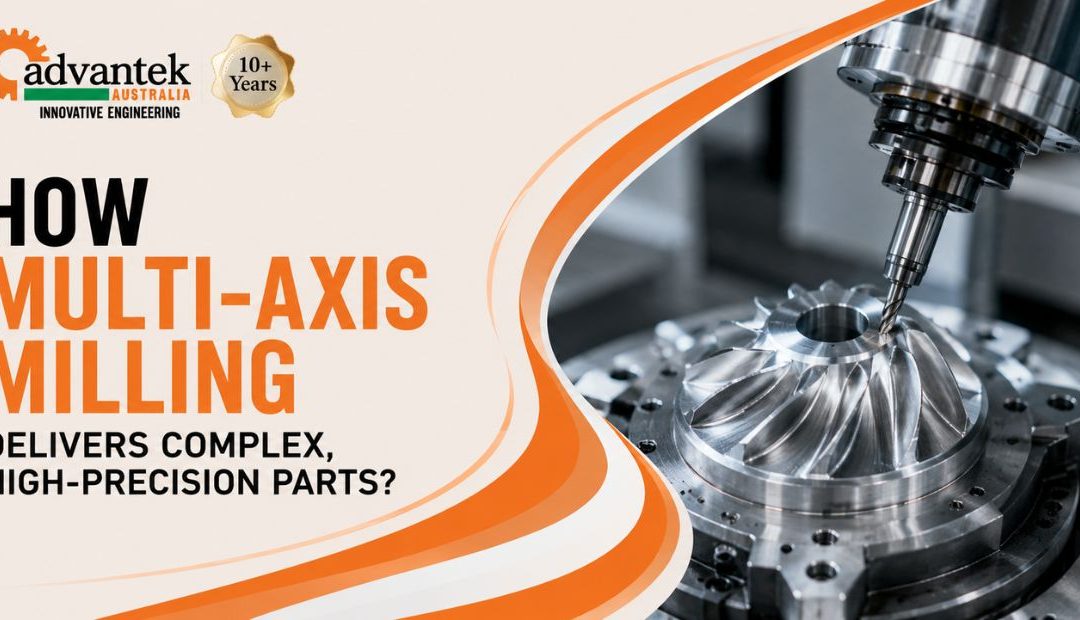
  • 5-axis Milling- essentially allows the manufacturer to reach virtually any surface of a part without reclamping, which helps retain accuracy and provides the perfect finish.
  • Multi-axis machining further cuts down the time for prototyping, small batch, or full production runs.
  • The integration of CAD/CAM software, high-speed spindles, and contemporary tool path strategies shows even further potential to improve quality.

5-axis milling provides wonderlands when manufacturing components with delicate features, sweeping curves, or deep cavities; those could be just impractical-if not outright impossible-to achieve on 3-axis machines.

Technical Comparison: 5 Axis Milling vs 3 Axis Milling

Future/ Aspect

3 Axis Milling

5 Axis Milling

Dimensional Capability

X, Y, Z movements only

X, Y, Z + rotation A (tilt) & B (rotate)

Component Complexity

Simple to moderate

Highly complex & organic shapes

Setup Time

Multiple setups, more fixturing

Single setup, less fixturing

Lead Time                   

Longer (more manual intervention)

Shorter (automation & efficiency)

Precision/Tolerance         

Good, but limited by repositioning

Excellent, with higher repeatability

Tool Access

Restricted—difficult for undercuts

Full access, ideal for undercuts

Risk of Human Error

Higher (due to repositioning)

Lower (automated and continuous)


5 Axis Milling in Australia: Meeting Growing Demand

More advanced products and competing on the international arena made 5 Axis milling in Australia gain popularity. Advanced workshops such as Advantek Australia have procured this technology and provide world-class precision to clients in aviation, med-tech, automotive, defence, mining, and many other areas.

Now with the ability to efficiently create complex parts with aluminium, titanium, stainless steel, and exotic alloys, local industries are no longer required to seek offshore alternatives for their demanding projects. It makes more sense for a local expert as there is quicker turnaround time, better local experience, and lower supply chain risk.

Why Choose Advantek Australia for Your Complex Component Requirements?

When your project sets the highest standards in complex component manufacturing and precision machining, working with a team that has technical mastery, modern equipment, and a focus on customer satisfaction is worth it.
Advantek Australia sets itself apart with:

  • Top-Grade 5-Axis Machining Centres:Having the industry’s best 5-axis milling machines, the centre maintains the equipment internally to ensure the accuracy and the reliability of the cut that remain intact with time.
  • Experienced Team: Our engineers carry decades of experience and come with innovative solutions for the most challenging design and manufacturing problems.
  • From Start to Finish: Every step of the way-from initial concept and design to prototyping, production, and quality assurance-we will be right there with you.
  • Flexible Capacity:Large jobs, small jobs, one-off precision prototypes, or large-scale production runs, we can do it all!
  • Commitment to Quality: Rigorous inspection and certification procedures, which in all cases meet if not exceed the examination imposed by the most demanding industries.

Being a collaborative partner for innovation, speed, and reliability, Advantek Australia will stand with you for that tiny single complex part or for the large volume productions.

Conclusion: Ready to Take Your Project Further?

Precision matters. Complexity is not a barrier, but a challenge to be met with the right technology and expertise. If you’re looking to achieve the best results in your next manufacturing project, 5 axis milling delivers a superior blend of accuracy, efficiency, and geometric freedom. And with Advantek Australia, you get state-of-the-art capability paired with dedicated local service.

Contact Us Today

Phone: +61 2 9604 8772 | +61 423 706 357  

Email: sa***@*******************om.au  

Website: https://advantekaustralia.com.au

Let’s engineer the future together—start your complex component journey with Advantek Australia.

The Role of Reverse Engineering in Modern Manufacturing

The Role of Reverse Engineering in Modern Manufacturing

The Role of Reverse Engineering in Modern Manufacturing

Have you found yourself dealing with a vital machine part breaking down, only to learn that the replacement is merely not being manufactured anymore? Or have you felt a renewed sense of frustration by the months or weeks spent in the supply chain in order to procure a single component party shipment? Your thoughts might have run towards maybe that would be a quicker path to prototype production without jeopardising time or finances.

So, if any or all of these troubles sound familiar, you are just like the others. These have become typical hurdles across the modern manufacturing industry in Australia. Now, what if we could design a better, more sure way to overcome all these? Enter reverse engineering services-would-be alternative to dealing with antiquated parts, supply chain interruptions, and rapid prototyping.

What is Reverse Engineering?

Reverse engineering is a procedure by which a physical product is deconstructed to study its design, function, and operation. Using a plethora of scanning technologies, 3D engineering, and CAD, engineers get hold of exact details from pre-existing parts, assemblies, or entire systems, with the output usually in the form of a digital drawing ready to be used for duplication, improvement, or integration into fresh manufacturing processes.

The major steps include:

  • 3D scanning or manual measurement of original part
  • Creation of digital models using CAD for reverse engineering
  • Analysis for product improvement or adaptation
  • Reproduction through modern manufacturing methods

How Reverse Engineering Solves Supply Chain Issues

Supply chain disruptions always pose an imminent threat in today’s interlinked markets, where delays or completely discontinuations affect production schedules and profitability. Australian firms often work through suppliers overseas for parts, sometimes for equipment no longer supported by the original manufacturer.

Reverse engineering service is local and reliable for recreating critical legacy parts in cases where they are unavailable or simply obsolete. From a minus CAD-generated model, manufacturers can immediately produce replacements, shorten the downtime and ensure continuous operation irrespective of the international supply chain dependency.

Addressing Legacy Parts and Obsolete Components

Many businesses in Australia operate legacy machinery originally supplied from overseas or by companies no longer in business. Procuring spare parts for such equipment can be nearly impossible.

With product reengineering in Australia, engineers can:

  • Digitally capture ageing or worn parts
  • Restore original functionality or improve design
  • Manufacture compatible components using local resources
  • Extend the lifespan of valuable assets

Reverse engineering is the family of technologies that serves the purpose of renovation so that companies can get maximum productivity and assistance without stripping the cost of a complete and total setup.

Accelerating Prototyping and Innovation

Being an innovating core of manufacturers, rapid prototyping requires reverse engineering to perform quick digitisation and alteration of an existing component to get a prototype of a new product or adaptation or upgrade; thanks to CAD reverse engineering, designers can refine faster and iterate, allowing them to avoid expensive trial and error and engineer a better-performing product.

Benefits include:

  • Shorter turnaround times from concept to prototype
  • Cost-effective product development
  • Risk reduction through digital testing and validation

Why Choose Advantek Australia for Reverse Engineering and Product Reengineering?

When selecting a partner for reverse engineering services and product reengineering in Australia, trust and expertise matter. Advantek Australia stands out because of its:

  • Full Capabilities: Using cutting-edge scanning and CAD technology for simplest up to the most complex products
  • Local Know-How: Thorough knowledge of the unique manufacturing landscape and regulatory requirements in Australia
  • Custom Solutions: Custom approaches for legacy part reproduction, design improvements, or rapid prototyping
  • Clear Communication: Fixed timelines for projects, detailed reporting, and continuous client support

From one spare part to turnkey projects, Advantek will make every effort to guarantee quality, precision, and efficiency through every step.

Conclusion: Take the Next Step with Advantek Australia

Disassembling and analysing a part can open a world of possibilities for manufacturers in Australia. It helps rescue supply chain troubles, refurbish legacy equipment, and create a platform for faster innovation. Don’t let outdated parts interfere with your business or delay your timelines.

Contact Advantek Australia today to talk on reverse engineering and product reengineering. Together with you, we can secure your future with solutions of a world-class standard, fine-tuned for the Australian market.

Take control of your manufacturing future—partner with Advantek Australia now!