
Unlocking Precision: The Ultimate Guide to CNC Machined Parts
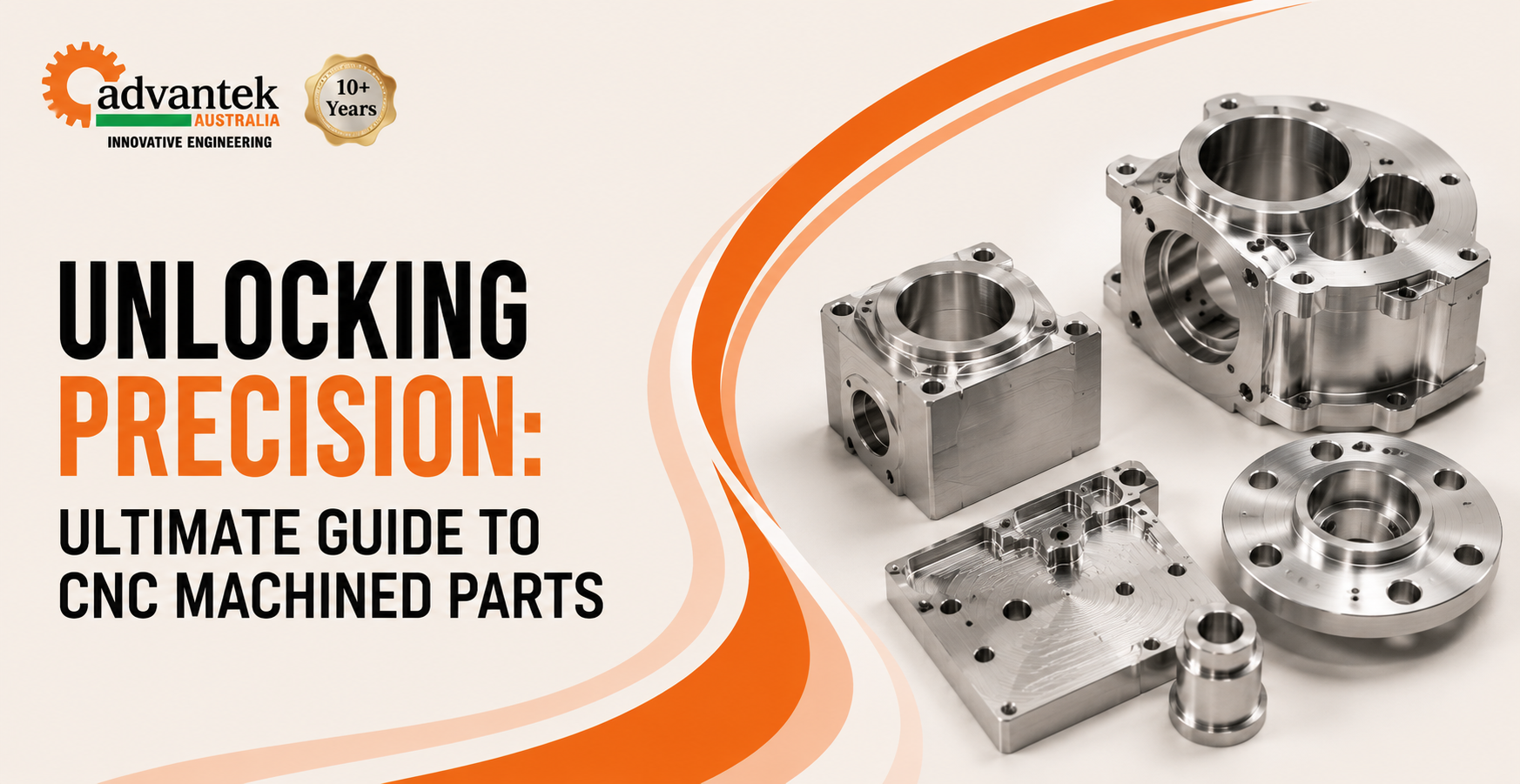
If you’ve ever wondered how a bracket, shaft or housing goes from a digital drawing to a component that fits perfectly first time, the answer almost always involves CNC machined parts. Computer Numerical Control (CNC) machining has become the backbone of Australian manufacturing because it delivers accuracy, repeatability and speed that manual processes simply can’t match.
For engineers, product designers and procurement managers, choosing the right manufacturing process can make or break a project. Get it wrong and you’re looking at delayed timelines, blown budgets or parts that don’t fit together properly. Get it right, and you have a reliable supply of components that meet spec every single time.
CNC machined parts are components manufactured using computer-controlled cutting tools that remove material from a solid block (or “blank”) to create a precise, finished shape. This subtractive process allows manufacturers to produce complex geometries with tight tolerances, consistent quality and minimal waste. At Advantek Australia, we’ve spent years helping businesses across the country solve exactly this kind of manufacturing challenge from our Wetherill Park workshop in Sydney.
Quick Summary (TL;DR)
- CNC machined parts are made by cutting material away from a solid blank using computer-guided tools.
- CNC milling and CNC turning are the two most common CNC machining processes.
- CNC machining suits both low-volume prototyping and large-scale production runs.
- Common materials include aluminium, stainless steel, brass, nylon, Delrin and acrylic.
- Tolerances as tight as ±0.01mm are achievable depending on material and part geometry.
- Costs depend on material, complexity, tolerance requirements and order volume.
- CNC machining offers better accuracy and material strength than 3D printing for functional parts.
- Choosing an experienced local manufacturer reduces lead times and quality risk.
What Are CNC Machined Parts?
CNC machined parts are physical components produced when a computer-controlled machine follows programmed instructions to cut, drill, or shape raw material into a finished part. The process starts with a CAD (Computer-Aided Design) model, which is converted into CAM (Computer-Aided Manufacturing) toolpaths that tell the machine exactly where and how to cut.
Unlike manual machining, where an operator manually adjusts feeds, speeds and tool positions, CNC machines execute these movements automatically and with far greater precision. This means every part in a production run comes out virtually identical, which is critical for industries where fit and function can’t be left to chance.
Common CNC machined parts include:
- Brackets and mounting plates
- Shafts, spindles and pins
- Housings and enclosures
- Gears and pulleys
- Custom fittings and connectors
- Jigs, fixtures and tooling components
How Does CNC Machining Work?
CNC machining is a subtractive manufacturing process, meaning it starts with a solid block of material and removes the excess until the final shape remains. The two core methods used across most Australian workshops, including ours, are CNC milling and CNC turning.
CNC Milling
CNC milling uses rotating cutting tools to remove material from a stationary workpiece. It’s ideal for parts with flat faces, slots, pockets, holes and complex 3D contours. Modern CNC milling centres can operate across multiple axes, allowing a single setup to produce intricate geometries that would take several manual operations to achieve.
CNC Turning
CNC turning works the opposite way: the workpiece rotates on a CNC lathe while a stationary cutting tool shapes it. This process is best suited to cylindrical or round components such as shafts, bushings and threaded parts. Turning is generally faster and more cost-effective for round geometries than milling.
Many components require both processes. A shaft might be turned to its basic cylindrical form, then milled to add a keyway or flat face. This is why working with a manufacturer that operates both CNC lathes and CNC milling centres under one roof, as Advantek Australia does, keeps projects moving without the delays of outsourcing between suppliers.
Why Choose CNC Machined Parts Over Other Manufacturing Methods?
Businesses often compare CNC machining against 3D printing (additive manufacturing) and injection moulding when deciding how to produce a part. Each method has its place, but they’re not interchangeable.
|
Factor |
CNC Machining |
3D Printing |
Injection Moulding |
|
Best for |
Functional, load-bearing parts |
Rapid prototypes, complex internal shapes |
High-volume identical parts |
|
Material strength |
High, uses solid engineering materials |
Lower, layer-dependent strength |
High, but limited to plastics |
|
Tolerance accuracy |
Very tight (±0.01–0.05mm typical) |
Moderate |
Tight, but tooling-dependent |
|
Upfront tooling cost |
Low to none |
None |
High (mould tooling) |
|
Ideal volume |
Low to high volume |
Low volume, one-offs |
Very high volume only |
|
Lead time |
Fast, no tooling wait |
Fastest for simple shapes |
Slow (mould production) |
For most engineering applications where strength, precision and material performance matter, CNC machined parts strike the best balance between accuracy, durability and cost, particularly when you don’t yet have the order volume to justify expensive injection moulding tools.
What Materials Are Used for CNC Machined Parts?
Material selection has a direct impact on a part’s strength, weight, cost and suitability for its environment. A good manufacturing partner will help you weigh these factors against your application before cutting begins.
|
Material |
Typical Properties |
Common Applications |
|
Aluminium |
Lightweight, corrosion-resistant, easy to machine |
Housings, brackets, aerospace and automotive parts |
|
Stainless Steel |
High strength, corrosion-resistant, durable |
Fasteners, medical components, food-grade equipment |
|
Brass |
Good conductivity, corrosion-resistant, easy to machine |
Electrical fittings, decorative components, valves |
|
Copper |
Excellent conductivity, ductile |
Electrical connectors, heat exchangers |
|
Nylon |
Tough, low friction, wear-resistant |
Gears, bushings, industrial rollers |
|
Acetal (Delrin) |
Dimensionally stable, low friction |
Precision gears, bearings, mechanical parts |
|
UHMWPE |
Impact-resistant, low friction, chemical-resistant |
Wear strips, conveyor components |
|
Polycarbonate |
Impact-resistant, optically clear |
Machine guards, sight windows, enclosures |
|
Acrylic |
Rigid, clear, good weather resistance |
Signage, display components, covers |
|
ABS |
Tough, impact-resistant, cost-effective |
Prototypes, housings, consumer product parts |
If you’re unsure which material suits your application, it’s worth discussing your load requirements, operating environment and budget with your machining partner before finalising a design.
What Industries Use CNC Machined Parts?
CNC machined parts are used wherever precision and reliability matter. Industries commonly relying on custom CNC machining include:
- Manufacturing and industrial equipment
- Automotive and transport
- Medical and scientific equipment
- Electronics and electrical fittings
- Agriculture and mining equipment
- Aerospace and defence
- Construction and infrastructure
Whether it’s a one-off replacement part for ageing machinery or a full production run for a new product, the underlying manufacturing principles stay the same: accurate design, correct material selection and tightly controlled tolerances.
How Do You Choose the Right CNC Machining Partner?
Not all machining workshops offer the same level of capability, quality control or communication. When evaluating a potential supplier, consider the following checklist:
- Does the workshop machine both plastics and metals, or only one?
- Can they handle low-volume prototyping as well as larger production runs?
- Do they use modern CAD/CAM software for accurate programming?
- Can they hold the tolerances your application requires?
- What quality checks are performed before parts are dispatched?
- Are they based locally, reducing freight time and communication delays?
- Can they advise on material selection and design for manufacturability?
- Do they have experience in your specific industry?
Advantek Australia was built on exactly these principles. Starting from a single CNC machine, the business has grown into a full-service precision engineering workshop in Wetherill Park, Sydney, supporting customers across Australia with both plastic and metal CNC machined parts.
What Affects the Cost of CNC Machined Parts?
Several factors combine to determine the final cost of a CNC machined component:
- Material choice– engineering plastics are generally cheaper than metals like stainless steel.
- Part complexity– more features, tighter pockets and multi-axis geometry increase machining time.
- Tolerance requirements– tighter tolerances demand slower speeds and more careful setup.
- Order volume– larger runs reduce the cost per part due to setup efficiencies.
- Surface finish– polishing, anodising or coating adds additional processing steps.
- Turnaround time– rush orders may carry a premium due to production scheduling.
Getting an accurate quote usually requires sharing a CAD file or drawing with your machining partner, along with your required quantity and tolerance specifications.
What Tolerances Can CNC Machining Achieve?
CNC machining is prized for its repeatability. Standard CNC milling and turning can typically hold tolerances of around ±0.05mm, while tighter tolerances down to ±0.01mm are achievable on precision equipment for critical applications. The achievable tolerance depends on the material, part geometry, machine capability and the complexity of the feature being cut. It’s good practice to only specify tight tolerances where they’re functionally necessary, since unnecessarily tight tolerances add cost without adding value.
Is CNC Machining Suitable for Prototyping and Low-Volume Production?
Yes. CNC machining is well suited to both prototyping and low-volume production because it doesn’t require expensive tooling like injection moulding does. This makes it a practical option for businesses testing a new design, running a pilot production batch, or manufacturing spare parts for legacy equipment where original tooling no longer exists. Because CNC machined prototypes are cut from the same engineering-grade materials used in final production, they also give a realistic indication of how the finished part will perform.
Frequently Asked Questions
How long does it take to manufacture CNC machined parts?
Turnaround depends on part complexity, material availability and order volume, but many workshops can produce prototype parts within days and larger production runs within one to a few weeks.
Can CNC machining produce both plastic and metal parts?
Yes. CNC machines can cut a wide range of plastics and metals, including aluminium, stainless steel, brass, nylon, acetal and polycarbonate, provided the workshop has the right tooling and expertise for each material.
Is CNC machining more accurate than 3D printing?
Generally, yes. CNC machining removes material from solid engineering-grade stock, producing stronger parts with tighter tolerances than most 3D printing processes, which build parts layer by layer.
What file formats do I need to get a CNC machining quote?
Most workshops accept standard CAD formats such as STEP, IGES or DXF files, along with technical drawings showing critical dimensions and tolerances.
Do I need a minimum order quantity for CNC machined parts?
No. One of the advantages of CNC machining is that it’s cost-effective for single prototype parts as well as large production runs, unlike processes that require dedicated tooling.
How do I know which material is right for my part?
The right material depends on factors like load-bearing requirements, operating environment, corrosion exposure and budget. An experienced machining partner can help you weigh these factors against your application.
Can CNC machined parts be finished or coated?
Yes. Common finishing options include anodising, powder coating, bead blasting, polishing and painting, depending on the material and intended use of the part.
Get Expert Advice on Your Next CNC Machined Parts Project
Choosing the right manufacturing process, material and tolerances can feel overwhelming if you’re not machining parts every day. That’s exactly where an experienced partner adds value. The team at Advantek Australia has helped businesses across the country turn design concepts into precision-engineered plastic and metal components, from single prototypes through to full production runs.
If you’re planning a project and want practical advice on material selection, tolerances or production timelines, get in touch with Advantek Australia’s Wetherill Park workshop to discuss your requirements and request a quote.
Get In Touch
Get In Touch

ISO 9001:2015 CERTIFIED

Address
3/80 Hassall Street,
Wetherill Park NSW 2164
Follow Us
© Copyright 2024 All Rights Reserved. Website Design & Developed By WebGlobals