
How to Determine the Right CNC Machine Size for Your Production Needs
How to Determine the Right CNC Machine Size for Your Production Needs
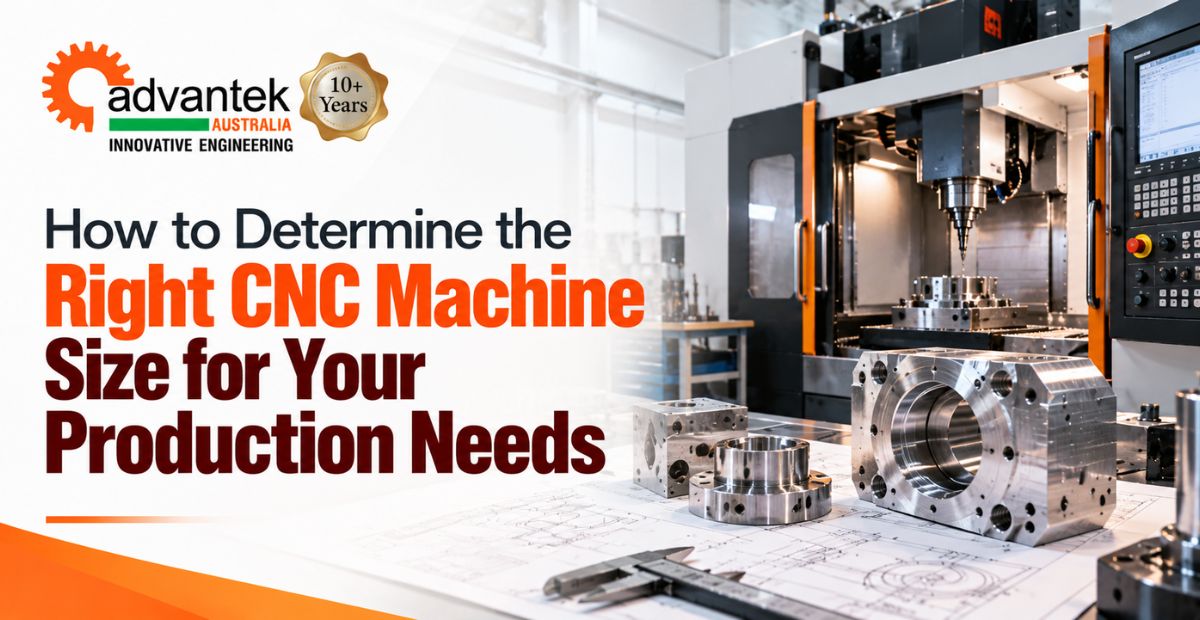
Choosing a CNC machine, or a CNC manufacturing partner, without thinking about size and capacity is one of the most common and costly mistakes in production planning. A machine that’s too small can’t handle your parts or volumes. One that’s oversized ties up capital and floor space you don’t actually need. Either way, the mismatch shows up later as delays, bottlenecks, or unnecessary cost.
This question matters whether you’re specifying equipment for your own workshop or, more commonly for most Australian businesses, choosing a CNC machining partner whose equipment needs to match your part sizes, tolerances and production volumes.
To determine the right CNC machine size for your production needs, assess your part dimensions, required tolerances, material type, production volume and batch frequency, then match these against a machine’s work envelope, spindle power and axis travel. For most businesses sourcing components rather than buying equipment outright, this translates into choosing a CNC machining partner, such as Advantek Australia in Wetherill Park, Sydney, whose machine capacity genuinely suits the parts you need made, both now and as your production grows.
Quick Summary (TL;DR)
- Match CNC machine size to your part dimensions, not just your current order volume.
- Consider work envelope, spindle power and axis travel, not machine size alone.
- Tighter tolerances often require more rigid, higher-precision machines.
- Material hardness affects the machine power and tooling needed for efficient cutting.
- Plan for future production growth, not just your immediate part requirements.
- Small parts don’t always need small machines if batch volumes are high.
- A CNC partner with varied machine capacity offers more flexibility long term.
- Getting machine size wrong leads to bottlenecks, delays or wasted capacity.
Why Does CNC Machine Size Matter for Production?
CNC machine size isn’t just about whether a part physically fits on the bed. It affects cycle time, achievable tolerances, tooling options, and how efficiently a workshop can run your job alongside others. A machine that’s undersized for a part might require awkward setups, multiple operations, or simply can’t hold the tolerance you need. An oversized machine running small, simple parts can be inefficient and more costly per unit than necessary.
Getting this right early avoids two expensive outcomes: parts that can’t be produced accurately, or production capacity that’s paid for but never fully used.
What Factors Determine the Right CNC Machine Size?
Several factors combine to determine the ideal machine size and capability for a given part or production run.
Part Dimensions and Geometry
The physical size of your part, including its length, width, and height, determines the minimum work envelope required. Complex geometries with deep pockets or tall features may also need additional Z-axis travel beyond what the raw dimensions suggest.
Required Tolerances
Tighter tolerances generally demand more rigid machines with better thermal stability and finer control. A machine capable of holding ±0.5mm tolerances isn’t necessarily suitable for parts requiring ±0.02mm accuracy, regardless of whether the part physically fits within its work envelope.
Material Type and Hardness
Harder materials, such as stainless steel, require more spindle power and torque than softer materials like aluminium or engineering plastics. A machine that’s perfectly capable of machining acetal or nylon efficiently may struggle, or wear tooling excessively, when cutting hardened steel.
Production Volume and Batch Size
A one-off prototype has very different machine requirements to a production run of several thousand identical parts. High-volume work often benefits from machines with automated tool changers, pallet systems or multi-axis capability to reduce cycle time and manual intervention.
Future Growth and Flexibility
It’s worth considering not just your current requirements but where your production is likely to head. Choosing a partner with a range of machine sizes and capabilities avoids the disruption of switching suppliers once your parts, volumes or tolerance requirements change.
How Do You Match Part Size to Machine Capability?
Use the table below as a general guide when assessing whether a machine’s capability suits your part.
|
Part Characteristic |
What to Look For in a Machine |
|
Small precision components |
High-precision CNC mill or lathe with fine tolerance capability |
|
Large brackets or housings |
Larger work envelope with sufficient X, Y and Z axis travel |
|
Cylindrical shafts or bushings |
CNC lathe with appropriate bar capacity and turning length |
|
Complex multi-feature parts |
Multi-axis CNC milling centre to reduce repositioning |
|
Hardened or tough materials |
Higher spindle power and torque, with suitable tooling |
|
High-volume identical parts |
Machines with automated tool changing and efficient cycle times |
What’s the Difference Between Machine Size and Machine Capability?
This is a common point of confusion. A larger machine isn’t automatically more capable of producing accurate parts, and a smaller machine isn’t automatically limited to simple work.
|
Factor |
Machine Size |
Machine Capability |
|
What it refers to |
Physical work envelope and bed size |
Precision, rigidity, spindle power, and control systems |
|
Determines |
Whether a part physically fits |
Whether tolerances and finish requirements can be met |
|
Common misconception |
Bigger machines handle all jobs better |
Larger machines can be less precise for small, delicate parts |
|
Best approach |
Match envelope to part dimensions |
Match rigidity and control to tolerance and material needs |
In practice, both size and capability need to align with your part. A small, high-tolerance component often performs better on a precision machine sized appropriately for it, rather than a large-format machine better suited to bigger, less delicate parts.
Should You Choose a CNC Machine or a CNC Machining Partner?
Most businesses don’t need to purchase and maintain their own CNC equipment. Unless you’re running extremely high, consistent volumes in-house, working with an established CNC machining partner is usually more practical.
Advantages of using a CNC machining partner instead of buying equipment:
- Access to a range of machine sizes and capabilities without capital investment
- No responsibility for maintenance, tooling, or machine downtime
- Flexibility to scale production up or down as demand changes
- Access to experienced operators and CAD/CAM programming support
When buying your own CNC machine might make sense:
- Extremely high, consistent production volumes over the long term
- Highly proprietary processes that benefit from in-house control
- Sufficient in-house engineering expertise to manage the equipment
For most businesses across Australia, particularly those with variable order sizes or evolving product designs, partnering with an experienced CNC workshop offers far more flexibility than committing to a single machine size upfront.
How to Choose the Right CNC Machine for Your Business in Australia
When evaluating a CNC machining partner rather than buying equipment outright, the “right machine size” question becomes about whether the workshop’s overall capability matches your needs.
- Confirm the range of machine sizes and work envelopes they operate
- Ask about spindle power and suitability for your specific material
- Check their tolerance capability against your part’s requirements
- Discuss both your current volume and expected future growth
- Ask whether they can handle both prototyping and full production runs
- Review examples of parts similar in size and complexity to yours
What Happens If You Choose the Wrong Machine Size?
Choosing a machine, or a manufacturing partner, that doesn’t genuinely match your part requirements tends to cause predictable problems:
- Parts that require multiple setups or operations, increasing cost and lead time
- Difficulty holding required tolerances, leading to rejected parts
- Excessive tooling wear when machine power doesn’t match material hardness
- Inefficient use of machine time on jobs that are too small or too large for the equipment
- Production bottlenecks if volume outgrows the machine’s realistic capacity
Frequently Asked Questions
How do I determine the right CNC machine size for my production needs?
Assess your part dimensions, required tolerances, material type, production volume and expected growth, then match these against a machine’s work envelope, spindle power and precision capability.
Does a bigger CNC machine always mean better quality?
No. Larger machines suit larger parts, but small, precise components are often better produced on machines specifically suited to fine tolerance work rather than large-format equipment.
How do I choose the right CNC machine for my business in Australia?
Most businesses are better served by partnering with an established CNC machining workshop that offers a range of machine sizes and capabilities, rather than purchasing dedicated equipment.
What's the difference between machine size and machine capability?
Machine size refers to the physical work envelope a part must fit within, while capability refers to the precision, rigidity, and power needed to meet tolerance and material requirements.
Should I buy my own CNC machine or use a machining partner?
Unless you have extremely high, consistent production volumes, using an experienced CNC machining partner is generally more practical and cost-effective than purchasing equipment.
Can one machine handle both prototyping and full production runs?
Often yes, particularly for small to mid-volume work, but very high-volume production may benefit from machines with automated tool changing and reduced cycle times.
How does material affect the right CNC machine choice?
Harder materials, such as stainless steel, require more spindle power and torque than softer materials like aluminium or engineering plastics, which affects which machine suits the job.
What happens if I choose a CNC machine that's too small for my part?
The part may not fit the work envelope at all, or may require multiple setups and operations, increasing both cost and the risk of accuracy issues.
Talk to Advantek Australia About the Right Machining Capability for Your Parts
Matching the right machine size and capability to your production needs makes the difference between a smooth, cost-effective manufacturing process and one full of avoidable delays. Advantek Australia operates a range of CNC lathes and CNC milling centres from its Wetherill Park workshop, giving businesses across Australia access to the right capability for parts of almost any size, material or tolerance requirement.
If you’re planning a new production run or unsure what machine capability your parts actually need, get in touch with Advantek Australia to discuss your requirements and request a quote.
Get In Touch
Get In Touch

ISO 9001:2015 CERTIFIED

Address
3/80 Hassall Street,
Wetherill Park NSW 2164
Follow Us
© Copyright 2024 All Rights Reserved. Website Design & Developed By WebGlobals
Recent Comments