
How Multi-Axis Milling Delivers Complex, High-Precision Parts?
Manufacturing has come a long way from the days of hand files and manual lathes. Today, the parts that go into aircraft, medical devices, mining equipment, and industrial machinery are shaped with a level of accuracy that the human hand simply cannot replicate. Multi-axis CNC milling sits right at the heart of that shift, and it’s changing what Australian manufacturers can deliver to their clients.
When you look at modern production demands, tolerances are tighter, lead times are shorter, and design complexity has gone through the roof. Understanding machining techniques that keep up with those demands is no longer optional for businesses that want to stay competitive.
What Multi-Axis Milling Actually Means for Modern Manufacturing?
Traditional milling works on three axes: X, Y, and Z. That covers left-right, front-back, and up-down movement. It gets the job done for simple shapes, but the moment a design calls for curved surfaces, undercuts, angled bores, or compound geometry, three axes start showing their limits fast.
Multi-axis milling adds rotational movement into the mix. A 4-axis machine introduces rotation around the X-axis, while a 5-axis machine can tilt and rotate the cutting tool or the workpiece simultaneously. This means a single setup can machine surfaces from multiple angles without the operator needing to stop, reposition, and re-clamp the part.
The practical result is fewer setups, fewer handling errors, and geometry that would be physically impossible to achieve with conventional methods. Parts that once required three or four separate machining operations can now come off a single run, accurate, clean, and ready for use.
CNC Milling vs Manual: Why the Gap Has Never Been Wider?
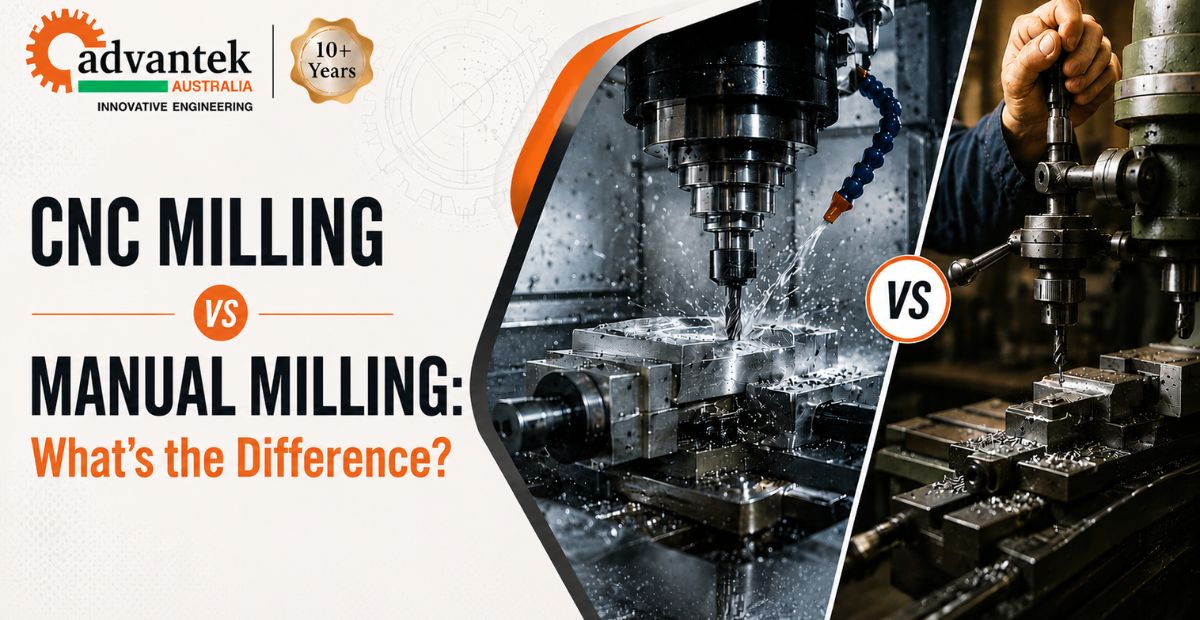
There’s a reason most serious manufacturers have moved away from purely manual processes. The debate around CNC milling vs manual machining isn’t really a debate anymore. Manual machining still has its place for one-off repairs or very basic stock work, but for anything complex, CNC wins on every front.
A skilled manual machinist working at peak performance can hold tolerances of around ±0.1 mm on a good day. A modern CNC machine operating under controlled conditions regularly holds ±0.005 mm or tighter without breaking a sweat. That’s a difference of twenty times the precision, achieved consistently across every single part in a production run.
Beyond accuracy, there’s the matter of repeatability. A manual operator gets tired. Tools wear and go unnoticed. Measurements drift. A CNC machine follows its program exactly the same way, whether it’s running the first part of the day or the fiftieth. For industries where a part failure could mean injury or equipment damage, that consistency is non-negotiable.
The Numbers Behind Precision: A Quick Comparison
The data below reflects industry-standard benchmarks comparing manual and CNC milling across key performance areas:
| Performance Factor | Manual Milling | 3-Axis CNC Milling | 5-Axis CNC Milling |
| Typical Tolerance | ±0.1 mm | ±0.025 mm | ±0.005 mm |
| Setup Time (complex part) | 2–4 hours | 45–90 minutes | 20–40 minutes |
| Repeatability Across Run | Moderate | High | Very High |
| Operator Dependency | Very High | Low | Very Low |
| Surface Finish Quality | Moderate | Good | Excellent |
| Suitable for Complex Geometry | Limited | Moderate | Extensive |
| Scrap Rate (avg. production run) | 5–10% | 1–3% | Below 1% |
How Complex Geometry Becomes Possible With Multi-Axis Setups?
Multi-axis CNC opens up part geometries that don’t exist in the world of manual work, not because machinists aren’t skilled enough, but because the physics of hand-operated tooling simply won’t allow it.
Examples:
Consider an impeller blade for a pump or turbine. Each blade has a twisted, compound-curved surface that transitions smoothly from root to tip. On a manual mill, creating that surface would require dozens of repositions, and the result would still show faceting and inconsistency across the curve.
On a 5-axis CNC machine, the tool follows the surface contour in one continuous path. The finish is smooth, the dimensions are exact, and the part performs as the engineer designed it. The same logic applies to medical implants with organic shapes, aerospace brackets with integrated features, and automotive components with precision-bored angles.
Material Versatility and Why It Matters for Australian Industry
Multi-axis CNC milling isn’t limited to aluminium or mild steel. Modern machines handle titanium, Inconel, hardened tool steel, engineering plastics, and composites with the same programmed precision. That versatility matters enormously for sectors like mining, defence, oil and gas, and medical manufacturing, all of which are significant in Australia.
Examples:
- Mining: For instance, Mining components take brutal punishment in abrasive environments. They need to be made from hard, wear-resistant materials and machined to exacting dimensions so they fit and seal correctly in service. A part that’s even slightly out of tolerance can fail catastrophically underground. Multi-axis CNC machining removes that risk by producing precisely the right components, made from the exact material the application demands.
- Medical Devices:Medical device manufacturing has its own set of demands. biocompatible materials, surface finishes that won’t harbour bacteria, and dimensional accuracy measured in microns. These are requirements that make manual machining completely unsuitable as a production method.
The Role of CAD/CAM Integration
The real power behind multi-axis milling is the software that drives it. Modern machining techniques rely heavily on CAD/CAM integration, where a 3D design file is translated directly into machine tool paths with minimal human interpretation in between.
This means the engineer’s intent is preserved all the way through to the finished part. There’s no interpretation by a machinist who reads a 2D drawing and makes judgment calls. The geometry defined in the CAD model is the geometry that gets cut. Changes to designs can be pushed through quickly by updating the program rather than retraining an operator or redoing manual setups from scratch.
CAM software also optimises tool paths automatically, choosing cutting strategies that reduce cycle time, manage heat buildup, and extend tool life. Optimisation adds up to significant cost savings and more consistent output quality over time for high-volume runs.
Tolerances, Surface Finish, and Why They Define Part Performance
Two things determine whether a precision part actually works in service, and they are dimensional accuracy and surface finish. Multi-axis CNC milling delivers on both in ways that manual processes can’t match.
Dimensional accuracy means the part is the size it’s supposed to be within a defined tolerance band. For most precision engineering work, that’s somewhere between ±0.01 mm and ±0.05 mm. In more demanding applications like aerospace or medical, it is tightened to ±0.005 mm or less. CNC machines achieve this through rigid construction, temperature compensation, and closed-loop feedback systems that detect and correct for tool deflection in real time.
Surface finish is about how smooth the machined surface is at a microscopic level. A rough surface creates stress concentrations, traps contaminants, increases friction, and can cause fatigue cracking over time. A high-quality CNC surface finish, achieved through controlled feed rates and finishing passes, eliminates those failure points and extends the service life of the component significantly.
Industries Driving Demand for Precision CNC Machining in Australia
Australia’s industrial base is more diverse than many people realise, and the demand for precision-machined parts comes from several directions at once.
- Aerospace and defence are obvious drivers, with both sectors requiring parts that meet strict certification standards and traceability requirements. Mining and resources remain a backbone industry, constantly requiring wear-resistant components, valve bodies, pump housings, and custom tooling.
- The medical and pharmaceutical sector is growing rapidly, with Australian companies producing implantable devices, surgical instruments, and diagnostic equipment for both domestic and export markets. Each of these sectors places manufacturing demands that only high-end CNC processes can reliably meet.
- The renewable energy sector is creating fresh demand for precision components in turbine systems, hydraulic assemblies, and structural hardware for solar and wind installations. It’s a wide and growing market, and manufacturers that have invested in multi-axis capability are the ones positioned to serve it.
Choosing the Right Machining Partner
Not every CNC shop is equipped to handle genuinely complex work. The difference between a facility that runs basic 3-axis work and one that operates full 5-axis multi-pallet systems is significant in terms of capability, quality systems, and the expertise of the people running the machines.
- When evaluating a machining partner, the questions worth asking include:
- What is their machine capability in terms of axis count and work envelope?
- Do they operate quality management systems like ISO 9001?
- Can they work directly from CAD files?
- What industries have they supplied, and what’s their track record with tight-tolerance work?
A shop that can answer those questions confidently with documented evidence is one worth trusting with critical components.
How Advantek Australia Approaches Complex Precision Work?
For Australian businesses that need multi-axis milling done properly, Advantek Australia’s precision machining services represent a genuinely capable option. Their team works across a range of CNC machining disciplines, applying the kind of process severity of the complex parts demanded from initial design review through to final inspection and delivery.
What sets a team like Advantek’s apart isn’t just the machinery, it’s the engineering knowledge behind each job. Understanding how a part will be used, what forces it will experience, and what finish and tolerance it needs is the difference between a part that works and a part that fails. That level of applied expertise is what justifies choosing a specialist over a generalist shop quoting on price alone.
Whether it’s a one-off prototype, a short production run for a mining application, or a recurring contract for aerospace components, the right machining partner approaches each job as an engineering problem, not just a cutting task.
The Future of Multi-Axis Machining in Australian Manufacturing
The trajectory of CNC technology points clearly toward more automation, smarter toolpath software, and tighter integration between design and production. Machine learning is beginning to enter the CAM space, with software that can predict tool wear and adjust cutting parameters automatically.
For Australian manufacturers, these advances mean that the capability gap between local precision engineering and offshore alternatives is narrowing. When you factor in lead time, communication, freight risk, and intellectual property protection, local high-precision CNC machining becomes an increasingly compelling case over cheaper but slower offshore options. Australian manufacturers that invest in multi-axis capability now are positioning themselves on the right side of that growth curve.
Frequently Asked Questions
What is multi-axis CNC milling?
Multi-axis CNC milling uses machines that move a cutting tool along four or more axes simultaneously, allowing complex shapes and curved surfaces to be machined accurately in fewer setups.
How accurate is 5-axis CNC milling compared to manual machining?
A 5-axis CNC machine can hold tolerances as tight as ±0.005 mm, while manual machining typically achieves ±0.1 mm at best. That’s up to twenty times more precise.
Which industries in Australia use multi-axis CNC milling the most?
Aerospace, defence, mining, medical device manufacturing, and the energy sector are the biggest users of multi-axis CNC milling in Australia due to their strict part quality requirements.
Can CNC milling handle hard materials like titanium or Inconel?
Yes. Multi-axis CNC machines are routinely used to cut titanium, Inconel, hardened steels, and engineering composites with consistent accuracy across the full run.
What's the difference between 3-axis and 5-axis CNC milling?
3-axis machines move in X, Y, and Z directions. 5-axis machines add two rotational movements, enabling complex undercuts, compound angles, and curved surfaces without repositioning the part.
How do I know if my part needs multi-axis machining?
If your part has curved surfaces, angled features, undercuts, or requires tight tolerances across multiple faces, multi-axis CNC milling is likely the most efficient and accurate production method.
Get In Touch
Get In Touch

ISO 9001:2015 CERTIFIED

Address
3/80 Hassall Street,
Wetherill Park NSW 2164
Follow Us
© Copyright 2024 All Rights Reserved. Website Design & Developed By WebGlobals