
What is a CNC Router Machine? A Practical Guide for Australian Manufacturers
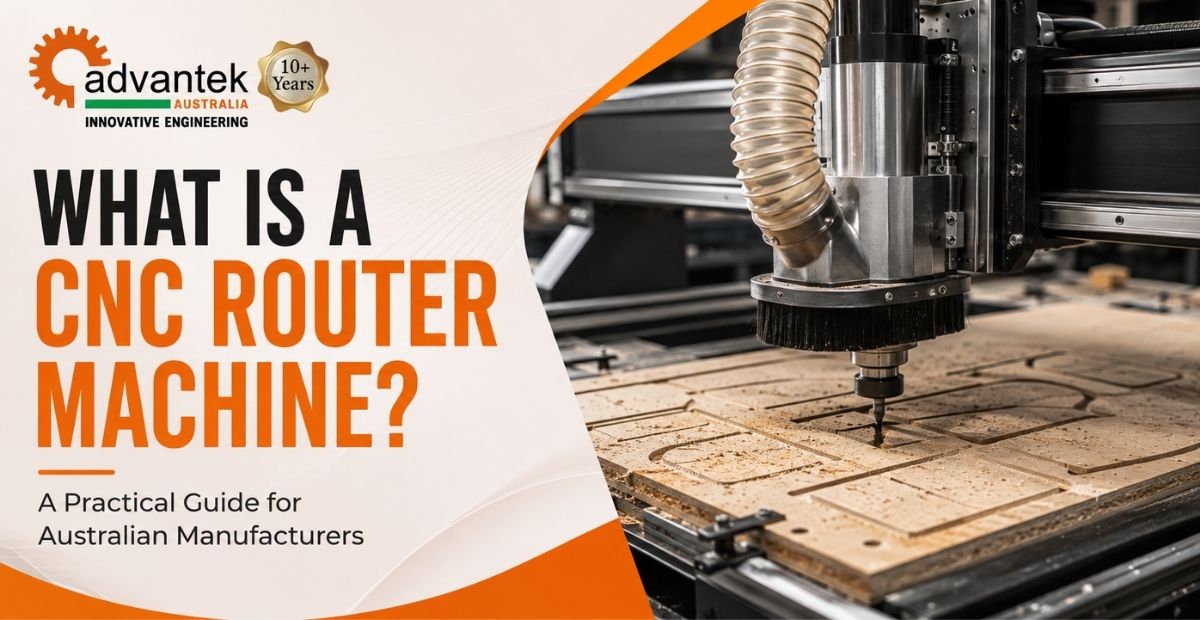
If you’ve been researching manufacturing options for cutting sheet materials, shaping panels, or producing flat and 3D components at scale, you’ve probably come across the term “CNC router” and wondered exactly how it fits into the picture. It’s a common point of confusion, especially for anyone comparing it against CNC milling or laser cutting.
Understanding what a CNC router machine actually does, and where it excels, helps you make better decisions about which manufacturing process suits your project, your budget and your material.
A CNC router machine is a computer-controlled cutting tool that uses a rotating spindle to cut, carve, engrave or shape materials such as wood, plastic, foam and softer metals. It follows a digital design file to move across the X, Y and Z axes with high accuracy, making it ideal for producing flat panels, signage, engraved components and larger-format parts that would be slow or impractical to machine on a smaller CNC mill. At Advantek Australia, we work with CNC technology daily from our Wetherill Park workshop in Sydney, helping businesses understand which process is the right fit for their components.
Quick Summary (TL;DR)
- A CNC router machine is a computer-guided cutting tool that shapes materials using a rotating spindle.
- CNC routing is best suited to wood, plastics, foam, composites and some softer metals.
- It’s commonly used for signage, panels, furniture components and large-format parts.
- CNC routers typically cut across large, flat sheet materials more efficiently than CNC mills.
- CNC routing differs from CNC milling mainly in spindle speed, rigidity and typical material range.
- Tolerances are generally looser than precision CNC milling or turning.
- Choosing between a CNC router and CNC mill depends on material, part size and required precision.
- Advantek Australia can advise on whether routing or precision CNC machining suits your part.
What is CNC Routing?
CNC routing is the process of using a CNC router machine to cut, carve or shape material according to a digital design. The word “CNC” stands for Computer Numerical Control, meaning the machine’s movements are programmed and automated rather than manually operated.
A CNC router works by holding a workpiece flat on a bed while a high-speed rotating spindle, fitted with a cutting bit, moves across the surface following a pre-programmed toolpath. This toolpath is generated from a CAD design, then converted into machine instructions through CAM software, similar in principle to CNC milling, but optimised for different materials and part geometries.
What is a CNC Router Used For?
CNC routers are widely used across trades and industries that need to cut, shape or engrave flat or large-format materials efficiently. Common applications include:
- Signage and display panels
- Furniture components and cabinetry parts
- Architectural panels and screens
- Foam patterns and packaging inserts
- Engraved plaques, plastics and acrylic signage
- Templates, jigs and prototyping in softer materials
- Large-format plastic sheet cutting
Because CNC routers can cover large bed sizes, they’re particularly useful for parts that would be inefficient or impossible to fit on a smaller-format CNC milling machine.
How Does a CNC Router Machine Work?
A CNC router works through a sequence that mirrors most CNC processes, adapted for its typical materials and larger work areas.
- Design creation– a CAD model or vector drawing defines the part shape.
- Toolpath generation– CAM software converts the design into a set of machine instructions.
- Material setup– a sheet or block of material is secured flat on the router bed, often using vacuum clamping.
- Cutting– the spindle rotates at high speed, moving along the programmed path to cut, carve or engrave the material.
- Finishing– parts are removed from the sheet and, if required, deburred, sanded or finished.
Because the spindle moves across a broad, flat bed rather than a compact enclosed work envelope, CNC routers are particularly efficient for cutting multiple parts from a single sheet in one operation, a process often called nesting.
What Materials Can a CNC Router Cut?
CNC routers are versatile, but they’re generally best matched to softer or lower-density materials compared to CNC mills, which are built for harder engineering metals.
|
Material |
Suitability for CNC Routing |
|
Plywood and MDF |
Excellent, one of the most common routing materials |
|
Solid timber |
Excellent, widely used in furniture and joinery |
|
Acrylic |
Excellent, common for signage and display panels |
|
Polycarbonate |
Good, suited to panels and protective components |
|
ABS |
Good, used for prototypes and lightweight parts |
|
Foam (PVC, EPS) |
Excellent, common for patterns and packaging |
|
Aluminium (thin sheet) |
Possible with the right tooling and spindle, but limited |
|
Stainless steel |
Not suitable, requires CNC milling instead |
If your part needs to be cut from a harder engineering metal like stainless steel or requires very tight tolerances, CNC milling or turning is generally a better fit than routing.
CNC Router vs CNC Mill: What’s the Difference?
This is one of the most common points of confusion for people new to CNC manufacturing, since both machines use a rotating cutting tool guided by a computer program.
|
Factor |
CNC Router |
CNC Mill |
|
Typical materials |
Wood, plastics, foam, soft sheet metals |
Aluminium, steel, brass and other engineering metals |
|
Rigidity |
Lighter frame, suited to softer materials |
Heavy-duty frame, suited to high cutting forces |
|
Typical tolerance |
Looser, generally not precision engineering grade |
Tight, often ±0.05mm or better |
|
Bed size |
Often large-format, good for sheet materials |
Typically smaller, enclosed work envelope |
|
Common use case |
Signage, panels, furniture, large flat parts |
Precision engineering components, functional parts |
In short, a CNC router prioritises speed and coverage over large, flat, softer materials, while a CNC mill prioritises rigidity and precision for engineering-grade metals and tighter-tolerance components.
Is a CNC Router the Right Choice for Your Project?
Choosing between CNC routing and precision CNC machining comes down to three main questions:
- What material are you using?Wood, plastics and foam suit routing; metals and precision plastics usually suit CNC milling.
- How tight are your tolerances?If your part needs to fit precisely with other components, CNC milling generally delivers more reliable accuracy.
- What’s the part’s function?Decorative, structural-lite or large-format parts often suit routing, while load-bearing or mechanical components usually need CNC machining.
If you’re unsure which process fits your application, it’s worth discussing your part’s material, function and tolerance requirements with an experienced CNC workshop before committing to a manufacturing method.
What Should You Consider Before Getting a Part CNC Routed?
- Confirm your material is genuinely suited to routing rather than precision milling
- Check whether your tolerance requirements can realistically be met
- Consider sheet size and nesting efficiency if producing multiple parts
- Factor in finishing requirements such as sanding, sealing or edge treatment
- Ask whether your supplier can also handle CNC milling if your project later needs tighter-tolerance components
Frequently Asked Questions
What is a CNC router machine?
A CNC router machine is a computer-controlled cutting tool that uses a rotating spindle to cut, shape or engrave materials such as wood, plastic and foam, guided by a digital design file.
What is a CNC router used for?
CNC routers are commonly used for signage, furniture components, architectural panels, foam patterns and cutting large sheets of plastic or timber.
What's the difference between CNC routing and CNC milling?
CNC routing typically suits softer materials like wood, plastics and foam with looser tolerances, while CNC milling is built for harder engineering metals and tighter, precision tolerances.
Can a CNC router cut metal?
Some CNC routers can cut thin, soft metal sheets like aluminium, but they’re not suited to harder metals such as stainless steel, which require CNC milling.
Is CNC routing accurate enough for engineering parts?
CNC routing can be accurate for many applications, but it generally doesn’t match the tight tolerances achievable with CNC milling, so it’s less suited to precision engineering components.
What software is used to design parts for CNC routing?
Parts are typically designed in CAD software, then converted into machine-ready toolpaths using CAM software, the same general workflow used across most CNC processes.
How big can a part be for CNC routing?
CNC routers often have larger bed sizes than CNC mills, making them well suited to large sheet materials and bigger flat components.
Should I choose CNC routing or CNC machining for my project?
It depends on your material, tolerance requirements and part function. An experienced CNC workshop can advise on which process best suits your specific application.
Your Title Goes Here
Your content goes here. Edit or remove this text inline or in the module Content settings. You can also style every aspect of this content in the module Design settings and even apply custom CSS to this text in the module Advanced settings.
Talk to Advantek Australia About Your CNC Manufacturing Options
Choosing the right method from the beginning saves time and avoids expensive rework, whether you need large-format routing, precise CNC milling, or a mix of different materials. The team at Advantek Australia has extensive experience across CNC machining, plastic engineering and metal engineering, helping businesses match the right process to the right part.
If you’re not sure whether CNC routing or precision CNC machining suits your project, get in touch with Advantek Australia’s Wetherill Park workshop to discuss your requirements and request a quote.
Get In Touch
Get In Touch

ISO 9001:2015 CERTIFIED

Address
3/80 Hassall Street,
Wetherill Park NSW 2164
Follow Us
© Copyright 2024 All Rights Reserved. Website Design & Developed By WebGlobals