
CNC Milling vs Manual Milling: What’s the Difference?
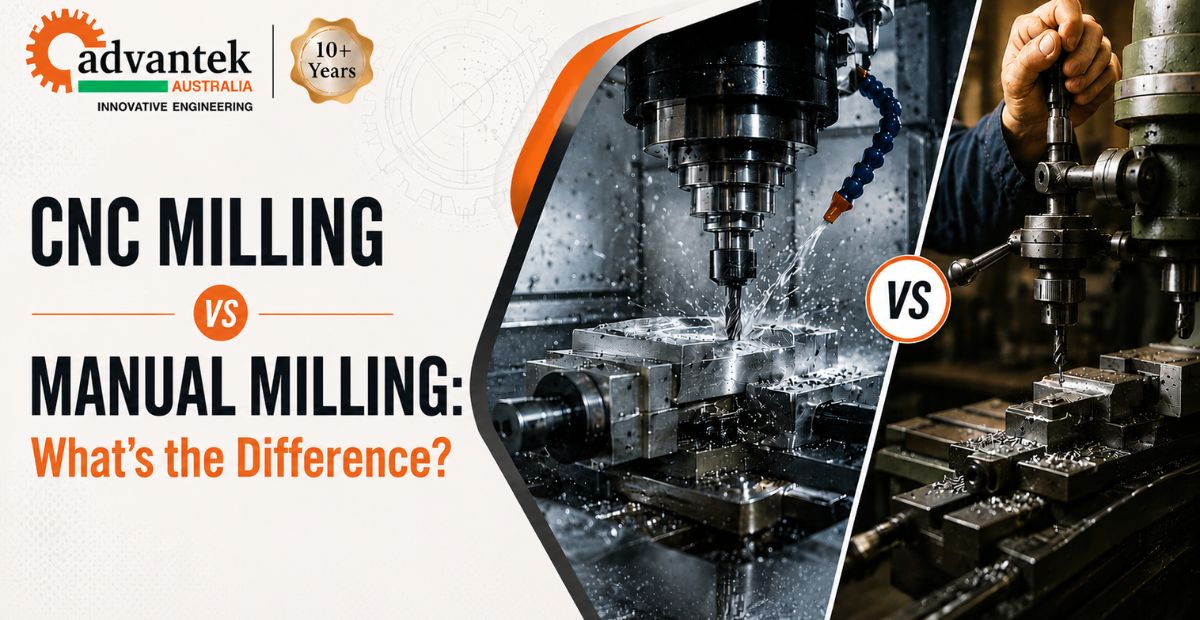
If you’ve ever had a part come back wrong, slightly off, uneven, or just not quite right, you already understand why the method of milling matters. Whether you’re in construction, automotive, aerospace, or general manufacturing, the way your parts are cut and shaped directly affects the quality of your final product.
Australia’s manufacturing sector is growing fast, and businesses are under real pressure to deliver more accurate work in less time. That’s where understanding CNC milling vs manual methods becomes less of a technical discussion and more of a business-critical decision.
This guide breaks it all down, what each method actually involves, where one beats the other, and why more Australian workshops and manufacturers are making the switch to smarter, computer-driven solutions.
What is Manual Milling and How Does It Work?
Manual milling is the traditional approach. A machinist physically operates the milling machine using hand cranks, levers, and dials to guide the cutting tool across a workpiece. Every movement depends on the skill, experience, and steady hands of the operator.
It’s a method that’s been around for well over a century, and it still has its place in some situations. For one-off jobs, quick fixes, or learning the fundamentals of machining techniques, manual milling gives operators a tactile, hands-on understanding of how metal behaves under a cutting tool. But it comes with significant limitations, the biggest being human error.
No matter how experienced a machinist is, fatigue sets in, attention drifts, and tolerances creep. When you’re running the same job across a hundred parts, consistency is nearly impossible to guarantee by hand alone.
What is CNC Milling and Why is it Different?
CNC stands for Computer Numerical Control. Instead of a human guiding every movement, a pre-programmed set of digital instructions tells the machine exactly where to cut, how deep to go, at what speed, and in what sequence. The result is a level of precision and repeatability that simply can’t be matched manually.
The machine reads G-code, a standard programming language used in manufacturing and executes each cut with the same accuracy every single time, whether it’s the first part or the five-hundredth. For businesses looking for CNC milling Sydney providers or anywhere across Australia, this consistency is often the deciding factor.
Modern CNC mills can also work across multiple axes simultaneously, allowing complex geometries and contoured surfaces that would take hours to achieve manually if they could be achieved at all.
CNC Milling vs Manual: How Do They Actually Compare?
Here’s a side-by-side look at how these two machining techniques stack up across the metrics that matter most to Australian businesses:
| Factor | CNC Milling | Manual Milling |
| Precision/Tolerance | ±0.001 mm achievable | ±0.1 mm typical |
| Production Speed | High runs continuously | Slow operator-dependent |
| Repeatability | Near-perfect across all parts | Varies with operator fatigue |
| Setup Time | Longer initial setup | Faster for simple one-offs |
| Labour Cost | Lower per unit at scale | Higher constant supervision needed |
| Complex Geometries | Easily achievable (3–5 axis) | Very difficult or impossible |
| Material Waste (Scrap Rate) | 1–3% average | 10–15% average |
| Operator Skill Required | Programming knowledge | Extensive hands-on trade experience |
| Ideal For | Medium to high volume production | Prototypes, repairs, training |
| Safety | Highly reduced human exposure | Lower manual contact with moving parts |
The numbers tell a clear story. At production scale, CNC milling reduces scrap, cuts labour costs, and delivers a consistently higher quality output.
Is CNC Milling More Precise Than Manual Milling?
Yes, by a significant margin. CNC milling can consistently hold tolerances as tight as ±0.001 mm, while manual milling typically achieves around ±0.1 mm under ideal conditions. For industries like aerospace, medical device manufacturing, or defence, where a fraction of a millimetre can mean the difference between a functioning part and a failed one, this isn’t a minor difference; it’s everything.
The secret lies in how instructions are executed. With CNC milling vs manual methods, there’s no reliance on muscle memory or operator focus. The same code runs the same path with the same feed rate every single time. It’s this repeatability that makes CNC the backbone of modern precision manufacturing.
Does CNC Milling Reduce Production Costs Over Time?
This is one of the biggest misconceptions in the industry. Many businesses hesitate at the higher upfront cost of CNC equipment and assume manual methods are cheaper. In reality, the economics flip quickly once you factor in labour, scrap, and rework.
Manual milling requires a skilled tradesperson to be present and actively operating the machine at all times. CNC milling, once programmed, can run with minimal supervision, meaning one operator can oversee multiple machines simultaneously. Over a production run of hundreds or thousands of parts, the labour cost per unit drops dramatically.
Then there’s scrap. Manual methods produce significantly more waste material due to human error. At current raw material prices in Australia, particularly for aluminium, stainless steel, and titanium, a 10–15% scrap rate adds up fast. CNC’s average scrap rate of 1–3% is a genuine commercial advantage.
What Industries in Australia Benefit Most From CNC Milling?
Across the country, industries that demand tight tolerances and complex part geometries are the biggest adopters of CNC technology. These include:
- Aerospace and defence,where every component must meet strict certification standards
- Automotivefor engine components, chassis parts, and custom fabrication
- Mining and resourcesfor heavy-duty wear parts that need to last in brutal conditions
- Medical deviceswhere dimensional accuracy is non-negotiable
- Oil and gasfor precision valve and fitting components
- Architecture and constructionfor custom structural and decorative metalwork
For businesses in these sectors, working with a CNC milling Sydney provider that understands both the technical and commercial demands of Australian industry isn’t just convenient, it’s essential.
Can Manual Milling Still Be Useful in Some Situations?
Honestly, yes, but in a narrow set of circumstances. Manual milling still makes sense for:
- Prototype development in the early stages, where a machinist needs to quickly remove material and test a rough concept without setting up a full CNC program.
- Repairs and one-off jobswhere the cost of programming isn’t justified.
- Trade training environments, where students learn the fundamentals of metal removal before moving on to CNC work.
But for any business thinking about growth, scalability, or consistency of product quality, manual methods create a ceiling that’s very difficult to break through. The skill gap in Australian manufacturing is also widening. Finding experienced manual machinists is increasingly difficult, while CNC operators trained in CAD/CAM software are easier to bring on board and upskill.
What Are the Different CNC Milling Techniques Used Today?
Not all CNC milling is the same. Depending on the job requirements, different approaches and machine configurations are used:
- 3-axis millingis the most common and handles the majority of standard flat and contoured parts by moving along X, Y, and Z axes.
- 4-axis millingadds a rotational axis, allowing the machine to work around cylindrical workpieces without re-clamping.
- 5-axis millingis the most advanced configuration, capable of machining highly complex three-dimensional shapes in a single setup, reducing handling time and improving accuracy significantly.
There’s also high-speed machining (HSM), which uses lighter cuts at much higher feed rates to reduce heat buildup and extend tool life. For Australian manufacturers working with difficult materials like titanium or hardened steel, HSM can be the difference between a tool that lasts a shift and one that lasts a week.
Understanding which of these machining techniques suits your job is something that experienced CNC providers assess from the outset, as it directly impacts both lead time and cost.
How Do You Choose the Right CNC Milling Partner in Australia?
Not all machining shops are created equal. When evaluating a CNC milling partner, these are the questions worth asking:
- What’s their equipment range?A shop with only 3-axis machines will struggle with complex geometry jobs.
- Do they offer in-house CAD/CAM programming?This reduces lead time and communication errors.
- What materials do they regularly work with?Experience matters because machining aluminium is very different from machining hardened tool steel.
- Do they have quality assurance processes in place?ISO certification and CMM inspection are markers of a serious operation.
- What’s their track record in your industry?Case studies and referrals speak louder than spec sheets.
For Australian businesses that need dependable, high-quality machining support, Advantek Australia’s services cover the full spectrum from CNC milling and turning to precision fabrication with the technical depth and industry experience to handle complex, demanding projects across a wide range of sectors.
Why is CNC Technology the Future of Australian Manufacturing?
Australia’s manufacturing sector is navigating a difficult landscape, with rising labour costs, skills shortages, global competition, and increasing demand for customised, high-tolerance components. CNC technology directly addresses all of these pressures.
Automation reduces dependence on hard-to-find specialist labour. Higher precision reduces warranty claims, rework, and material waste. Faster turnaround improves cash flow and customer satisfaction. The ability to store and re-run programs means that repeat orders are fulfilled faster and more cheaply each time they come in.
The shift from CNC milling vs manual isn’t just a preference; it’s an economic inevitability for any Australian business that wants to stay competitive in the next decade.
Frequently Asked Questions
What is the main difference between CNC milling and manual milling?
CNC milling uses computer-programmed instructions for automated precision cuts, while manual milling relies on an operator’s hands-on control. CNC offers far better accuracy, consistency, and production speed.
Is CNC milling more expensive than manual milling?
CNC has higher upfront costs but lower cost per part at scale due to reduced labour, less material waste, and faster production cycles compared to manual methods.
Can CNC milling handle all types of materials?
Yes. CNC milling works across aluminium, steel, stainless steel, titanium, brass, plastics, and composites, often with better results than manual methods on hard or exotic materials.
How accurate is CNC milling compared to manual?
CNC milling can hold tolerances of ±0.001 mm consistently. Manual milling typically achieves ±0.1 mm under ideal conditions, making CNC far superior for precision parts.
Where can I find reliable CNC milling services in Australia?
Advantek Australia offers professional CNC milling and precision machining services. Visit their website to explore their full capabilities.
Get In Touch
Get In Touch

ISO 9001:2015 CERTIFIED

Address
3/80 Hassall Street,
Wetherill Park NSW 2164
Follow Us
© Copyright 2024 All Rights Reserved. Website Design & Developed By WebGlobals